Imagine this.
One of your employees walks into a confidential management meeting wearing what appears to be an ordinary pair of glasses.
During the meeting, leaders discuss employee performance, staffing concerns, financial information and other sensitive matters.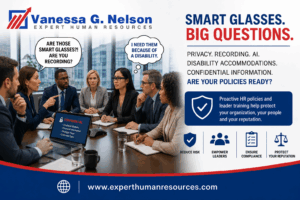
Then someone asks:
“Are those smart glasses?”
Suddenly, a simple pair of glasses creates some not-so-simple questions.
Can they record?
Were they recording the meeting?
Does your policy prohibit it?
What happens if the employee says the glasses are needed because of a disability?
Welcome to another emerging workplace challenge created by rapidly changing technology.
Smart Glasses May Be an HR Issue Sooner Than You Think
Smart glasses are becoming increasingly sophisticated and accessible. Depending on the technology, these devices may be capable of capturing audio, video or other information—and AI-enabled devices can create additional privacy and biometric concerns.
Employers may encounter smart glasses in several different ways. An employee may bring their own device to work. An employer may decide to use the technology for business purposes. Or an employee may request permission to use smart glasses as a disability accommodation.
That means this isn’t simply an IT issue.
It can quickly become an HR, privacy, accommodation, confidentiality and risk-management issue.
“We’ll Just Ban Them.” Not So Fast.
A leader’s first reaction may be:
“We don’t allow recording devices. Tell employees they can’t wear smart glasses.”
But employers should be careful with an automatic response.
A pending federal lawsuit discussed in a recent National Law Review article illustrates why.
An employee at Walt Disney World alleges that medical conditions affecting her vision led her healthcare provider to prescribe smart glasses. According to her amended complaint, Disney did not permit her to wear the glasses, and she subsequently asserted claims that include failure to accommodate, disability discrimination and retaliation under the Americans with Disabilities Act.
The case is pending, so these are allegations—not a court determination that the employer violated the ADA.
But the situation provides an important reminder for employers:
When an employee indicates that smart glasses or another emerging technology may be needed because of a disability, don’t automatically jump to yes or no.
The organization may need to engage in the ADA interactive process and evaluate the employee’s limitations, essential job functions, effectiveness of the requested accommodation, possible alternatives and any legitimate workplace concerns associated with the device.
But What About Everyone Else in the Room?
That’s where this gets particularly interesting.
Suppose an employee has a legitimate reason for wearing the device.
The employer may still have legitimate concerns.
What if the employee works around:
- Confidential employee information;
- Medical or patient information;
- Financial records;
- Customer information;
- Computer screens containing sensitive data;
- Proprietary business information; or
- Private workplace conversations?
Employers have to consider both sides of the equation.
How do we appropriately address an employee’s accommodation needs while also protecting confidential information, privacy and the legitimate interests of other people in the workplace?
That’s not necessarily a question a 10-year-old employee handbook was written to answer.
And Then There Is AI
Smart glasses can potentially take the issue beyond ordinary recording.
The National Law Review article discusses the potential for AI-enabled smart glasses to process biometric information. It points to reporting about an unreleased Meta feature called “NameTag,” which reportedly was designed to recognize individuals captured by smart-glasses cameras using biometric signatures or “faceprints.” Meta later removed the software components that would have enabled the function.
Now imagine technology like that inside a workplace.
The HR conversation becomes considerably bigger than:
“Are employees allowed to wear these glasses?”
Leaders may eventually need to consider questions involving what information is collected, who receives it, where it is stored, how long it is retained, whether appropriate notice or consent is required, how information is secured and which privacy or biometric laws may apply.
And those requirements can vary significantly by jurisdiction.
The Employee Handbook Test
Here’s the question I would encourage leaders to ask:
If an employee walked into work tomorrow wearing AI-enabled smart glasses, would your current policies tell your managers what to do?
Look at your handbook.
Does it adequately address:
Recording devices? Cameras? AI? Wearable technology? Confidentiality? Employee privacy? BYOD? Workplace monitoring? Disability accommodations?
And just as importantly:
Do your managers know how those policies work together?
The National Law Review authors specifically recommend that employers examine whether existing policies address AI, recordings, cameras, wearable technology and surveillance; whether actual workplace practices match those policies; whether revisions are needed; and whether policies appropriately distinguish among company-issued devices, employee-owned devices and devices used as reasonable accommodations.
My Recommendation to Employers
Don’t wait until a supervisor walks into HR and says:
“We caught someone wearing recording glasses. Can I make them take them off?”
That’s the wrong time to discover that nobody has considered the issue.
Instead, employers should consider reviewing their policies before the technology creates the incident.
And don’t look at one policy in isolation.
A smart-glasses issue could potentially touch several policies simultaneously, including technology use, recording, confidentiality, privacy, AI, workplace investigations, accommodations and employee conduct.
The objective isn’t necessarily to create a five-page “Smart Glasses Policy.”
It is to make sure your existing policies and management practices are prepared for the workplace technology employees are actually using—or may soon be using.
Because technology doesn’t wait for the employee handbook to catch up.
And neither does HR risk.
This article is provided for general HR educational purposes and is not intended as legal advice. Employers should evaluate applicable federal, state and local requirements and consult legal counsel regarding specific legal questions.