
The manager was trying to help.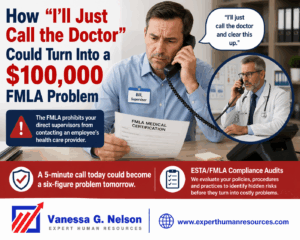
An employee submitted an FMLA medical certification, but something didn’t look quite right.
One section appeared incomplete. Some of the information was confusing, and the manager wanted clarification before approving the employee’s absence.
Then he noticed the physician’s telephone number.
“No problem,” he thought. “I’ll just call the doctor.”
It sounds reasonable.
It sounds efficient.
It could also be exactly the wrong thing to do.
Under the Family and Medical Leave Act, an employee’s direct supervisor may never contact the employee’s health care provider to authenticate or clarify an FMLA medical certification.
That small procedural mistake illustrates a much larger FMLA risk for employers:
Having a compliant policy doesn’t necessarily mean you have compliant practices.
What Should Happen When an FMLA Certification Raises Questions?
Employers are permitted to require medical certification in certain circumstances involving an employee’s own serious health condition or that of a qualifying family member.
But once that certification arrives, employers must follow specific procedures.
If a certification is incomplete or insufficient, DOL guidance says the employer must advise the employee in writing what additional information is necessary and generally provide the employee at least seven calendar days to cure the deficiency.
After the appropriate process, an employer may under certain circumstances contact the health care provider for authentication or clarification.
But the person making that contact matters.
The Department of Labor identifies appropriate representatives such as:
- A human resources professional
- A leave administrator
- A management official
- Another health care provider
The employee’s direct supervisor is specifically prohibited from making that contact.
Authentication and clarification also aren’t permission to conduct a broad medical investigation.
For example, authentication may involve confirming that information on the certification was completed or authorized by the health care provider. Clarification can involve understanding handwriting or the meaning of a response.
Employers generally may not use the process to obtain additional medical information beyond what the FMLA certification rules allow.
Why This Is More Than a Paperwork Problem
Consider a hypothetical scenario.
A supervisor receives a certification he believes is questionable.
Instead of referring the matter to HR, he contacts the physician himself.
The certification problem is subsequently mishandled.
The employee’s leave is denied.
The employee begins accumulating attendance points.
Eventually, the employee is terminated under the company’s attendance policy.
What started as:
“I’ll just call the doctor.”
could now be part of an FMLA interference or retaliation dispute.
And that’s where the financial exposure can become significant.
Could an FMLA Mistake Really Cost $100,000?
Depending upon the facts, imagine an illustrative financial scenario involving:
$30,000+ — Lost wages and benefits
$30,000+ — Potential liquidated damages
$20,000+ — Employee’s attorney fees and costs
$20,000+ — Employer’s legal defense expenses
Potential impact: $100,000+
And the financial calculation doesn’t necessarily capture management time, operational disruption, employee-relations consequences, possible equitable remedies, or reputational impact.
This is an illustrative example only. It is not a prediction of damages or legal costs in a particular FMLA matter.
The Policy-Practice Gap
Here’s where I believe employers should pay particular attention.
Suppose I review an organization’s employee handbook and find an excellent FMLA policy.
Does that mean the organization is compliant?
Not necessarily.
I would want to know what actually happens when an employee walks into a supervisor’s office and says:
“My doctor says I’m going to need surgery.”
Or:
“I need to take care of my mother for a few weeks.”
Or:
“My certification isn’t finished yet.”
Or when a manager looks at a certification and thinks:
“Something about this doesn’t look right.”
What happens next?
That’s where written policy meets actual management practice.
Four Questions Employers Should Ask Now
1. Who handles FMLA medical certifications?
Managers should understand exactly where certifications go and who has authority to communicate with health care providers.
2. What happens when a certification is incomplete or insufficient?
There should be a consistent process—not an improvised response by whichever manager happens to receive the paperwork.
3. Have managers been trained on what NOT to do?
FMLA training shouldn’t only teach managers what the law provides. Managers need to recognize situations in which they should stop, document what they know, and contact HR.
4. Do your actual practices match your written policy?
This may be the most important question of all.
A compliant handbook cannot compensate for inconsistent administration.
FMLA Compliance Happens on the Front Line
HR may understand FMLA.
Your employment attorney may have reviewed the policy.
Your forms may be current.
But supervisors and managers are often the first people to hear that an employee is sick, needs surgery, is caring for a family member, or needs recurring time away from work.
Their first response matters.
That’s why I believe employers should evaluate FMLA compliance beyond the handbook.
Look at the policy.
Look at the forms.
Look at the process.
Look at the documentation.
And especially look at what managers are actually doing.
Because a $100,000 FMLA problem doesn’t always begin with a manager intentionally breaking the law.
Sometimes it begins with a well-intentioned manager saying:
“I’ll just call the doctor.”
Could Your ESTA/FMLA Procedures Have Hidden Gaps?
Expert Human Resources conducts ESTA/FMLA Compliance Audits for Michigan employers, examining written policies, leave-administration procedures, documentation, and management practices to identify potential compliance and operational risks.
If you would like to discuss your organization’s ESTA/FMLA practices, contact Expert Human Resources for a confidential conversation.
This article is provided for general informational purposes and is not legal advice.